
Reviewed · TAIPEI TOURS
Taipei Calligraphy Workshop (DIY incl.)
Ancient ink, modern calm. Taipei’s Calligraphy Workshop offers a friendly two-hour introduction to Chinese calligraphy, with hands-on brush practice and a finished piece to take home. I like the small six-person limit, which gives you room to ask questions, and the clear blend of history, technique, and personal practice. The main drawback is the $79 price for two hours, especially if you are seeking a longer art class.
You make your own way to the studio at No. 16, Lane 151, Section 2, Jianguo South Road, in Da’an District. Instructors named in participant feedback include Teresa, Ruby, and Ginn, all praised for patience and clear teaching. You do not need artistic experience, but you should cancel at least 24 hours ahead if your plans change, since late cancellations are not refundable.
In This Review
- What makes this Taipei calligraphy class worth considering
- Arriving in Da’an for the two-hour workshop
- The opening lesson: calligraphy before technique
- Learning to hold and control the brush
- Practicing strokes, styles, and composition
- Creating your take-home calligraphy piece
- Why the setting and tea matter
- Is $79 good value for two hours?
- Who should book this Taipei experience?
- Booking advice and cancellation terms
- Should you book the Taipei Calligraphy Workshop?
- FAQ
- How long does the Taipei Calligraphy Workshop last?
- Where does the calligraphy class begin and end?
- How many people can join the workshop?
- Do I need previous calligraphy experience?
- What will I learn during the class?
- Is transportation included?
- Can I cancel for a full refund?
What makes this Taipei calligraphy class worth considering
- A six-person maximum keeps the lesson personal, with more direct help than you usually get in a large group class.
- You learn before you write, including the development of Chinese calligraphy and its major styles.
- The brush becomes the main lesson, as you practice holding, controlling, and guiding it across the paper.
- Your final artwork is yours to take home, giving the class a useful souvenir rather than just a memory.
- The setting includes Chinese paintings, calligraphy, and cultural objects, adding visual context to the instruction.
- Tea may be part of the welcome, making the class feel calm and unhurried, especially on a rainy afternoon.
Arriving in Da’an for the two-hour workshop
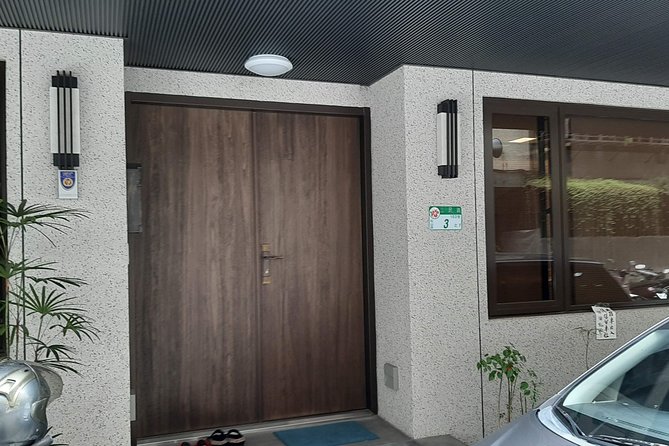
The class begins and ends at the same location in Da’an District: No. 16, Lane 151, Section 2, Jianguo South Road, Taipei City. You are responsible for getting there, but the studio is near public transportation, and the instructor can help with directions before the meeting.
That advance communication matters. Ruby was specifically praised for making arrival simple, which is useful when a meeting point is given as a lane and street number rather than a famous landmark. Keep the address on your phone and allow enough time to find the lane without rushing into the lesson.
The mobile ticket makes check-in straightforward. The workshop accepts service animals, and most people can participate. Since the group is capped at six, arriving on time is especially important. A late arrival would take up a larger share of a small class than it would in a large tour.
The studio itself adds to the experience. One session was described as a beautiful room filled with Chinese paintings, calligraphy, and cultural objects. That setting helps you understand that calligraphy is not simply handwriting practice. It is an art form tied to composition, movement, balance, and the character of the person holding the brush.
Easy to add on the same trip:
- From Taipei: Shifen, Jiufen, and Yehliu Guided Day Trip
★ 4.6 · 1,654 reviews - Full-Day Private Custom Taipei City Tour
★ 5.0 · 911 reviews - Taipei: Jiufen Night View and Shifen Day Tour
★ 4.6 · 870 reviews
The opening lesson: calligraphy before technique
The class begins with an introduction to Chinese calligraphy and its long development. You are shown different styles and given enough background to understand why the same written language can look so different from one period or tradition to another.
This short history lesson is practical, not just decorative. Once you know that calligraphy has several styles, the works you see in Taipei museums become easier to read as art. The class description specifically connects this introduction with a better appreciation of calligraphy in the National Palace Museum.
That makes the workshop a good companion to a museum visit. You will not become a professional calligrapher in two hours, but you will look at brushwork with a more informed eye. Instead of seeing only attractive black lines, you can start noticing pressure, rhythm, spacing, and the way a stroke begins and ends.
The introduction also makes the class accessible if you know little or no Chinese. One participant who already knew some Chinese still found that the instruction expanded her understanding. The lesson is about the writing system and the art of brushwork, not about testing your language skills.
Learning to hold and control the brush
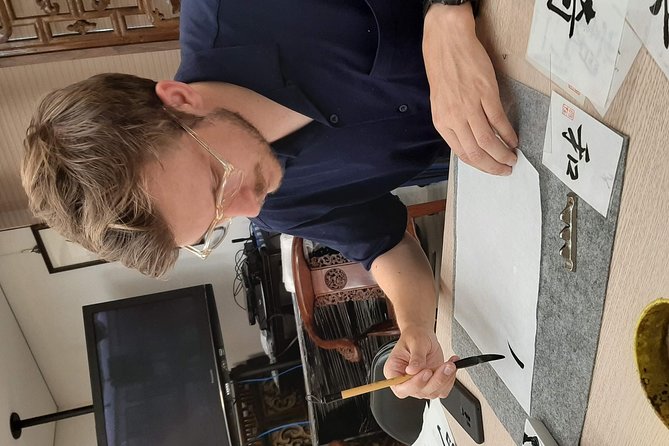
The practical part begins with your materials and the basic mechanics of the brush. You learn how to hold it and how to manage its movement, even if this is your first attempt.
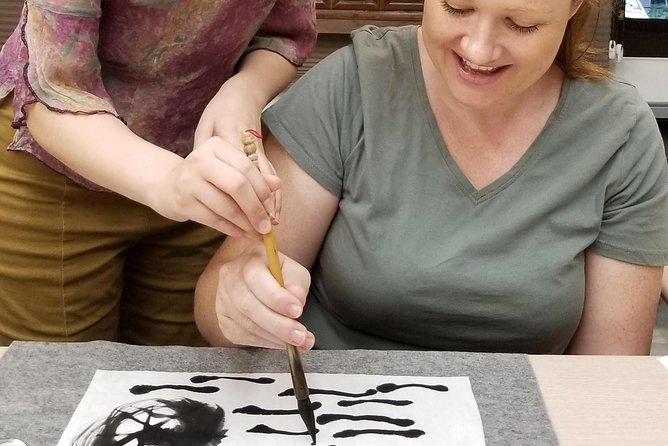
This is where the six-person limit earns its keep. Brush control is hard to understand from a lecture alone. You need someone to watch your hand, correct your position, and explain why a stroke looks too heavy, too thin, too fast, or too hesitant.
The workshop presents brush use as both a physical skill and an exercise in attention. You are encouraged to work with intention and stay present as the brush touches the paper. That mindfulness angle will appeal to anyone who wants a quieter cultural activity rather than another fast-moving sightseeing stop.
Do not expect perfect characters right away. Chinese calligraphy rewards control, but beginners are still learning how ink, paper, pressure, and movement work together. The value is in understanding the process and seeing improvement during the session.
The teaching style has received especially strong praise. Teresa was described as patient, gentle, positive, and generous with her explanations. Another participant praised her ability to teach complete beginners, while Ginn was noted for adapting the session to the student’s interests. Those details suggest a class built around encouragement rather than artistic performance.
Practicing strokes, styles, and composition
After the introduction, you practice calligraphy yourself. The sequence described for the workshop is sensible: first learn about the styles, then train with the brush, and finally make a personal piece.
This order keeps the class from becoming a simple craft activity. You understand what you are trying to do before you start producing work. You also get a chance to see how small changes in pressure and movement affect the mark on the page.
The exercise can be useful even if you do not consider yourself artistic. One participant said exactly that, yet still found the class enjoyable and worthwhile. Calligraphy gives beginners a clear structure, so you are not asked to invent a painting from nothing. You work within established forms while learning how your own hand affects the result.
The lesson may also appeal to people who already have some connection to Chinese language or culture. Someone with prior Chinese knowledge found the workshop added depth rather than repeating basic material. If you have visited the National Palace Museum, studied Chinese, or simply enjoy lettering and design, you may find the historical explanation especially rewarding.
The class is not described as a full course in a particular calligraphic style, and there is no promise of advanced instruction. Think of it as a well-guided first session. You leave with a better sense of the art’s foundations, not a finished mastery of them.
A few more Taipei trips worth lining up
- Taipei: Taipei 101 Observatory Deck Entry Ticket
★ 4.6 · 847 reviews - Full-Day Private Northern Taiwan Tour from Taipei with Pickup
★ 5.0 · 782 reviews - The Award-Winning Private Food Tour of Taipei: The 10 Tastings
★ 5.0 · 716 reviews - From Taipei: Thousand Island Lake and Pinglin Tea Plantation
★ 4.7 · 519 reviews
Creating your take-home calligraphy piece
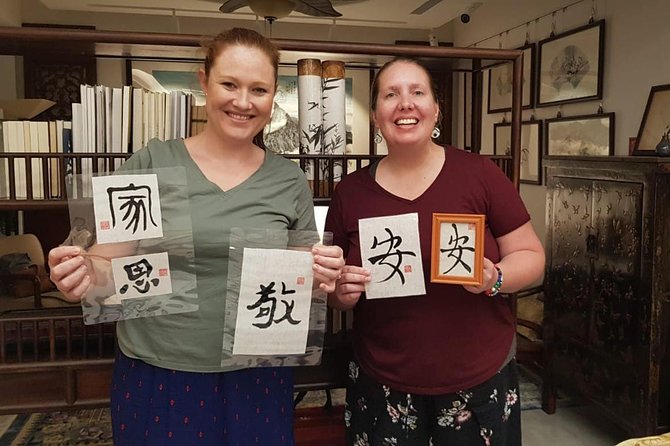
The final stage is the most memorable. You use the techniques from the lesson to create your own calligraphic work, which you can take home.
This gives the $79 fee a more tangible value. You are paying for instruction, cultural context, materials, a small-group format, and an object you made yourself. It is not a mass-produced souvenir pulled from a shop shelf. Your piece will show the marks of a beginner, but that is part of its appeal.
The final work also carries a story. You can remember the room, the instructor’s corrections, the feel of the brush, and the concentration required to complete each character. For a couple or a small group of friends, that shared activity may be more meaningful than another photo stop.
Do not judge the experience by whether your finished work looks museum-ready. The class is designed for beginners, and the satisfaction comes from seeing a traditional art form from the inside. If you want a professionally mounted calligraphy scroll or an advanced studio apprenticeship, this is not the right product. If you want to make something personal during a Taipei visit, it fits well.
Why the setting and tea matter
A calligraphy class can feel dry if it is treated as a technical demonstration. The surroundings help prevent that. Paintings, calligraphy, and cultural objects give you a visual reference for the principles being discussed.
Tea has also been served during a session, and it was described as delicious. That detail is not listed as a guaranteed inclusion, so I would not book solely for tea. Still, the refreshment helps explain why the workshop has been described as a relaxing way to spend a rainy Taipei afternoon.
This is a useful option when the weather is poor or you need a break from temples, museums, and crowded streets. Two hours indoors gives you a cultural activity with substance, without requiring a full day or a long transfer outside the city.
The calm pace may be less appealing if you want constant sightseeing or a packed itinerary. Calligraphy asks you to slow down. That is the point, but it also means the experience will feel quiet rather than energetic.
Is $79 good value for two hours?
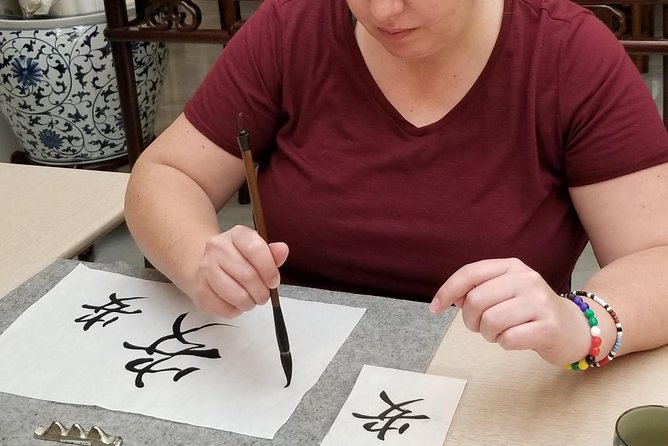
At $79 per person, this is not Taipei’s cheapest cultural activity. The price makes the most sense when you value direct instruction and a small group rather than simply wanting to try a brush for a few minutes.
The six-person cap is a major part of the value. In a class this small, the instructor has a realistic chance to notice your technique and respond to your questions. The fee also includes gratuities, so you do not need to calculate an additional tip.
Group discounts may improve the price for friends or family booking together. The take-home work adds another benefit, though the real value is the teaching. If you only want a quick souvenir, a market or museum shop will cost less. If you want to understand the craft and make your own piece, the workshop is easier to justify.
The class has earned a 4.9 rating from 19 published assessments, with 100 percent recommending it. That is a small sample, so I would not treat the rating as proof that every session will be perfect. Still, the praise is consistent on the points that matter most: patient teaching, clear explanations, an enjoyable atmosphere, and easy access.
Who should book this Taipei experience?
I would recommend it to first-time calligraphy students, couples, friends, and solo visitors who want a personal cultural activity. It is also a good fit if you have already seen Chinese calligraphy in a museum and want to understand how the marks are made.
The workshop suits you particularly well if you enjoy creative activities but do not consider yourself artistic. The instruction is beginner-friendly, and the goal is participation rather than a polished professional result.
It may also work for families, provided everyone can take part in a two-hour lesson and follow brush-handling guidance. Service animals are allowed, and most people can participate, but the available information does not specify children’s minimum ages or detailed mobility arrangements. Contact the provider before booking if you need those specifics.
You may want to skip it if your Taipei schedule is extremely tight, if $79 feels high for a two-hour activity, or if you prefer watching demonstrations to making your own work. The workshop is hands-on from start to finish, so participation is central.
Booking advice and cancellation terms
The experience is often booked about 24 days in advance, which suggests that you should reserve ahead if your dates are fixed. The group limit of six also means that available places can be more limited than on a standard city tour.
You receive confirmation at booking, and the activity is offered with a mobile ticket. Free cancellation is available up to 24 hours before the start time for a full refund. Changes or cancellations made less than 24 hours before the local start time are not accepted for a refund.
The activity requires a minimum number of participants. If the provider cancels because that minimum is not reached, you are offered another date or experience, or a full refund.
Should you book the Taipei Calligraphy Workshop?
Book it if you want to slow down, learn the basics of a traditional Chinese art, and leave Taipei with something your own hands made. The patient instructors, six-person limit, cultural setting, and clear progression from history to practice give the workshop more substance than a simple souvenir-making session.
I would be cautious only about the price and the short duration. Two hours is enough for a meaningful introduction, not enough for advanced skills. For a rainy afternoon, a museum companion, or a small-group cultural memory with friends, this is a strong choice. Reserve early, keep the meeting address handy, and arrive ready to make a few imperfect but personal strokes.
FAQ
How long does the Taipei Calligraphy Workshop last?
The workshop lasts approximately two hours.
Where does the calligraphy class begin and end?
It begins at No. 16, Lane 151, Section 2, Jianguo South Road, Da’an District, Taipei City, Taiwan 106. The activity ends back at the same meeting point.
How many people can join the workshop?
The class has a maximum of six participants.
Do I need previous calligraphy experience?
No. The workshop is beginner-friendly, and no experience is needed.
What will I learn during the class?
You learn about the history and development of Chinese calligraphy, different styles, brush handling, and basic techniques. You also create your own calligraphic piece.
Is transportation included?
No. Private transportation is not included. You make your own way to the meeting point, which is near public transportation.
Can I cancel for a full refund?
Yes. You can cancel at least 24 hours before the start time for a full refund. Cancellations or changes made less than 24 hours before the start time are not accepted for a refund.
Just listed around Taipei
- Vintage Taipei – Best of Taiwan and Sunset Walking Tour★ 5.0 · 4 reviews
- One Day Tour of Yilan, Zhang Mei Ama Farm★ 5.0 · 2 reviews
- Private Yangmingshan National Park Hiking Day Tour from Taipei★ 5.0 · 5 reviews
- Yilan 1-Day Private Tour to Kavalan Whisky & Cultural Gems★ 4.5 · 3 reviews
- Keelung Shore Excursion: Private 6H Natural Wonder & Seafood Tour★ 5.0 · 3 reviews
- One-day Yangmingshan NP Beitou Hot Spring Park and Tamsui Tour Package★ 5.0 · 2 reviews
- Yangmingshan National Park & Hot Spring Tour (afternoon )★ 3.0 · 2 reviews
- Best of Taiwan 9 Days Tour★ 3.5 · 3 reviews
Taipei Tours, compared.




Full-Day Private Northern Taiwan Tour from Taipei with Pickup
Read our review →
The Award-Winning Private Food Tour of Taipei: The 10 Tastings
Read our review →
Thousand Island Lake and Pinglin Tea Plantation
Read our review →
Food Tours w/ Top 10 Taiwan Food (Breakfast/Dinner)
Read our review →Browse the lists this tour appears in